As AI accelerates inside hiring — screening résumés, ranking candidates, cutting time-to-hire — accountability quietly slips away. 4TEGRITY is the framework that puts a person back at the center of every decision the system makes.
Most compliance frameworks were written for organizations with mature governance, but what about those who are moving fast with limited capacity. The gap is exactly where risk lives.
Screening, matching, and ranking are already running inside recruiting teams. The question isn't whether to adopt — it's how to govern what's already live.
When a system rejects a candidate, who owns that decision? The EU AI Act, NIST AI RMF, and ISO/IEC 42001 all assume someone does — and someone can prove it.
Mainstream compliance guidance assumes legal teams, governance boards, and dedicated AI ethics staff. Most HR and compliance leaders are running AI projects on top of a full-time day job.
Not a checklist. An integrity system that reinforces itself, anchored at every step to a person who can question the output.
Outputs that are appropriate and reliable in nuanced human contexts.
— Validity keeps the system honest.
Deploying AI with an active commitment to mitigating bias and upholding ethical standards.
— Legitimacy keeps it fair.
Recognizing subtle cues beyond purely quantitative metrics — the human signals a model can't read.
— Latent Impressions keeps it human.
Managing the pace of AI so it integrates without compromising oversight or candidate experience.
— Operational Cadence keeps it safe.
The pillars reinforce each other in a cycle — held together by a single thread: human oversight.
If you're leading AI adoption inside an HR, compliance, or talent acquisition function — and the framework docs feel like they were written for someone else — this is for you.
Owning the decision to deploy AI in hiring and accountable for what follows.
Running the change inside talent acquisition without a dedicated AI team.
Translating the EU AI Act, NIST AI RMF, and ISO/IEC 42001 into something operable.
Operating with limited bandwidth but real responsibility for the outcome.
Engineers building the model itself. 4TEGRITY speaks to the leader who owns the decision — not the data scientist who owns the code.
Practical throughout. AI treated as an augmentative tool that supports professional judgment, never a replacement for it.
A baseline read of your current AI footprint in hiring — what's live, what's shadow, what risks are already on the table.
A sequenced rollout pattern that respects organizational capacity without leaving accountability gaps.
How to brief leadership, hiring managers, candidates, and compliance in language that actually lands.
The specific behaviors, checkpoints, and overrides your team needs to keep oversight real, not performative.
Validity, Legitimacy, Latent Impressions, Operational Cadence — applied as a living integrity check, not a one-off audit.
"Can you explain, protect, prepare, monitor, respond to, and maintain accountability for your AI?"
Four grounded examples that move the principles from abstract to operational.
High-volume AI screening gone wrong — and what a Validity-first rebuild looked like.
A brand-led hiring programme forced to defend an automated rejection at scale.
How an Operational Cadence approach restored recruiter trust in a deployed system.
Hiring under heightened regulatory scrutiny — and what compliance looked like in practice.
Common concerns from leaders who already picked up the guide.
You probably don't need another framework — you need 4TEGRITY to operationalize the one you already have. The four pillars translate abstract RMF controls into daily behaviors your recruiters and compliance leads can actually run.
That's exactly why the guide is staged. You assess first, then move at the pace your capacity allows — without losing the integrity thread. It's designed to fold into work you're already doing, not stack on top of it.
No. The four pillars apply anywhere a human + AI system makes a decision about a person — recruitment, internal mobility, performance review. The cases skew regulated because the lessons are sharpest there.
Hardcover ($24.99) if you want it on the shelf, want to mark it up, or want the full reading experience. Kindle ($9.99) if you want it on every device instantly at a lower price. Same content, your preferred format.
Both editions are available on Amazon — order whichever fits how you read.
Hardcover ($24.99) and Kindle ($9.99), both on Amazon. Same content, same four pillars — pick the format that fits how you read.
Implementation is the whole point. You'll leave with the four pillars, a staged roadmap, and a closing readiness test you can run against your own deployment today.
It's grounded in a specific operational context — hiring — and built around a single accountability thread: a human at the center. The four pillars aren't abstract principles; they're behaviors you can run.
Each Kindle license is for one reader. Hardcover can be shared like any physical book. For organization-wide Kindle licensing, Amazon offers business terms through their bulk licensing program.
Roscoe Houston. 4TEGRITY grew out of his master's research — Change Management in E-Recruiting (National University, MA in Human Resources Management) — which began as a conference presentation and evolved into the four-pillar framework the book is built around.
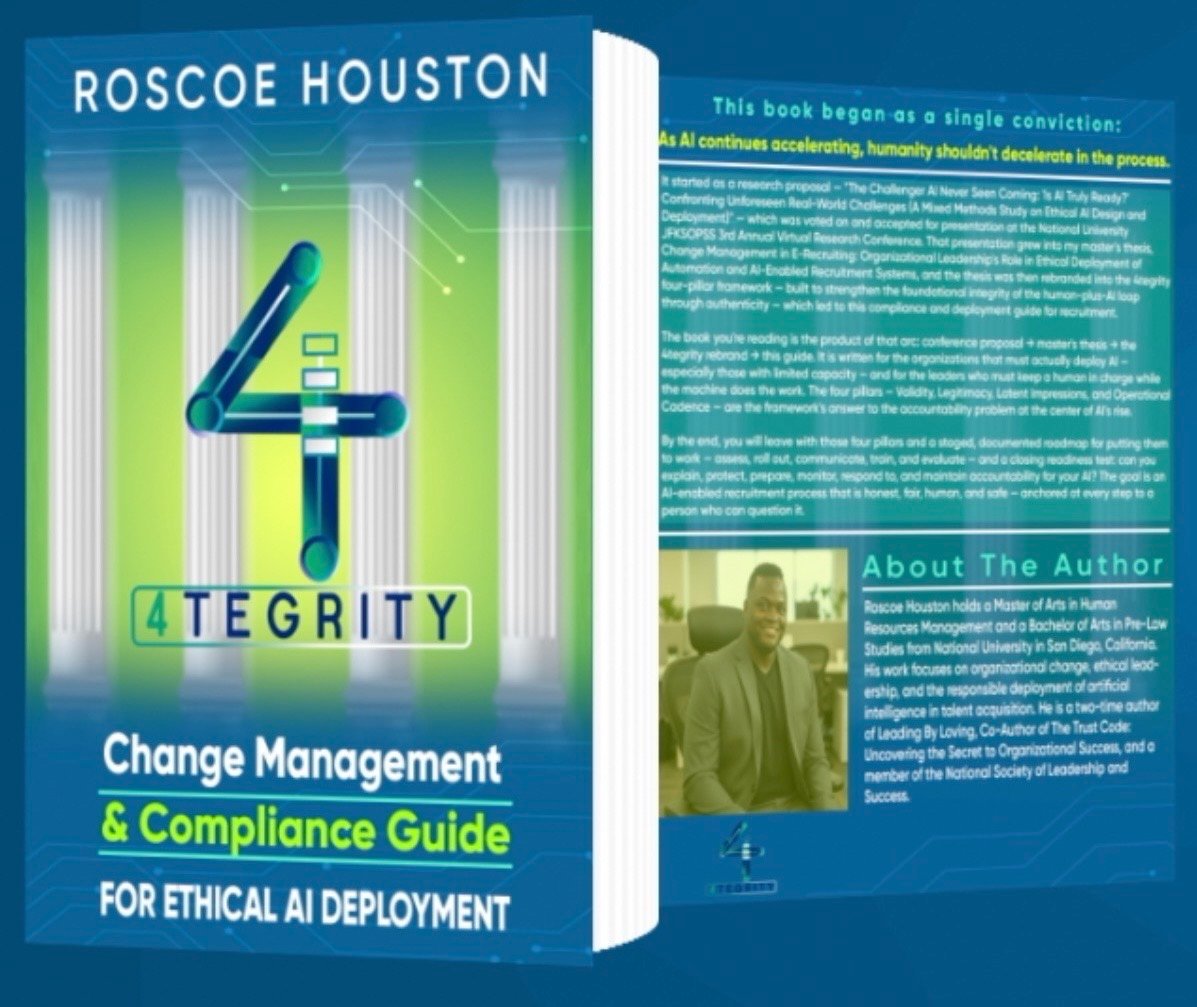
Whether you're a conference organizer booking a keynote, a corporate team bringing Roscoe in for a training session, or running an internal AI development event — pick a time below and he'll get back to you with availability and pricing.
Roscoe works with HR, compliance, talent acquisition, and OD specialist audiences who actually have to ship AI in hiring — not just talk about it. Sessions are tailored to your audience: research-backed, practical, and built for people running the deployment, not writing the abstract.
The 4-pillar framework, the staged rollout, the case studies, and the closing readiness test — ready when you are.
Buy on Amazon →